
文章內容

Bandwidth

❒ Definition of bandwidth
Bandwidth may be defined as the frequency range for signal transmission with an unit of Hertz (Hz) the same as frequency. We can understand the meaning of bandwidth with the following two perspectives. Please be noted that the communication must have a transmitter and a receiver in a pair, because we won’t talk to ourselves using cellular phone.
➤ Each pair of users must use a “frequency range” for talking: The communication cannot only use single frequency, but must utilize a frequency range, called bandwidth. Our speech is also impossible to have single frequency, but have variations with high pitch (high frequency) and bass (low frequency); in other words, our speech is actually sending out the voice (sound wave) within a certain frequency range (bandwidth). Similarly, when the high-frequency electromagnetic wave is used to transmit the voice signal, it must use a certain frequency range.
➤ Different pairs of users must use different frequency ranges for talking: Assuming A and B used electromagnetic wave with frequency of 900~901MHz for talking and C and D used electromagnetic wave with frequency of 901~902MHz for talking, the cellular phones will not distinguish who is talking to whom, but receive a certain frequency range, so the cellular phones of A and B will receive the electromagnetic wave with frequency of 900~901MHz and the cellular phones of C and D will receive the electromagnetic wave with frequency of 901~902MHz; in other words, all communication components only recognized the frequency but not the people. If A’s cellular phone can receive the electromagnetic wave with both frequencies of 900~901MHz and 901~902MHz at the same time, A may hear the voice from B, C and D at the same time.
❒ Bandwidth of GSM900
GSM900 system for second generation (2G) mobile phone utilizes digital signals and the spectrum is shown in Fig.1. The total bandwidth is 70MHz(890~960MHz). Because the cellular phone may simultaneously upload (speak) and download (listen), the bandwidth must be divided into two portions: 890~915MHz for upload and 935~960MHz for download:
➤ Uplink: Uplink utilizes 890~915MHz to transmit electromagnetic wave from cellular phone to base station for speaking, wherein the bandwidth of each voice channel is 0.2MHz(200KHz) and 1.6KHz is reserved between channels as the guard band. There are totally 124 voice channels capable of providing 124 people with the service for speaking.
➤ Downlink: Downlink utilizes 935~960MHz to transmit electromagnetic wave from base station to cellular phone for listening, wherein the bandwidth of each voice channel is 0.2MHz(200KHz) and 1.6KHz is reserved between channels as the guard band. There are totally 124 voice channels capable of providing 124 people with the service for listening.
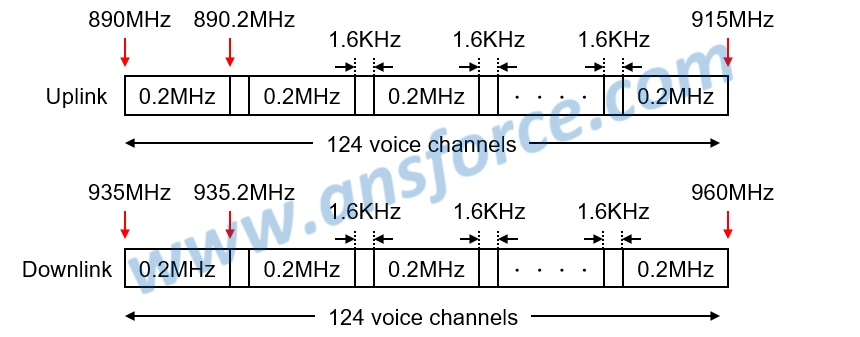
Figure 1: Electromagnetic wave spectrum of GSM900 system.
When we make a call using cellular phone, an upload voice channel and a download voice channel must be both occupied. If the bandwidth for each voice channel is wider, the voice quality will be better, but the total channel number will be fewer meaning that fewer people may use the bandwidth at the same time; on the opposite, if the bandwidth for each voice channel is narrower, the voice quality will be worse, but the total channel number will be more meaning more people may use the bandwidth at the same time, so you cannot have your cake and eat it too. Currently, GSM system uses the voice channel of 0.2MHz(200KHz), so the voice quality is almost the same as a conventional radio (AM or FM) and may be acceptable.
As described, it seems that GSM900 system can “simultaneously” provide 124 people with the service (speaking and listening), but what if more than 124 people want to make the call at the same time? They might hear from the system saying “Now the lines are all busy, please make the call later!” meaning there is no available voice channel for use. Then, is that 124 voice channels are somewhat too few? It may be the case any time that there are more than 124 people making calls at the same time! Then what? Let’s move on.
【Remark】
➤ Full-duplex: Enabling users simultaneously uploading and downloading (speaking and listening).
➤ Frequency Division Duplexing (FDD): Employing different frequency ranges (bandwidth) for uploading and downloading (speaking and listening).
➤ Frequency Division Multiple Access (FDMA): Employing different frequency ranges (bandwidth) for different users to use at the same time.
❒ Bandwidth of cable TV
The cable TV in the early stage uses analog signals and most of the bandwidth was used to transmit the analog cable TV channels. The spectrum distribution is shown in Fig. 2. The total bandwidth is about 750MHz and may be divided into three portions as follows:
➤ Uplink (10MHz~42MHz): The total bandwidth is 32MHz (42MHz-10MHz) reserved for uploading signals from the client to TV station. However, the electromagnetic wave in this frequency range is easily interfered by amateur radio broadcasting to generate noise, so there are more usage limitations.
➤ Analog cable TV band (54MHz~630MHz): The total bandwidth is 576MHz (630MHz~54MHz) for transmitting analog cable TV signals. The bandwidth for each TV channel is 6MHz, and 0.2MHz is reserved between channels, called “Guard band,” to prevent the mutual interference between different channels. There are totally 92 channels, such as frequency band 54~60MHz for HBA, frequency band 60.2~66.2MHz for CNN, and son on. When we select the channel using remote control in front of TV, actually we only change the frequency range received by TV. When TV received the electromagnetic wave of 54~60MHz, the screen plays the film of HBO; when TV received the electromagnetic wave of 60.2~66.2MHz, the screen plays the news of CNN.
➤ Digital band (630MHz~750MHz): The total bandwidth is 120MHz(750MHz~630MHz) for transmitting digital signals of digital TV, cable modem, and interactive value-added TV. The electromagnetic wave in this frequency range is the most stable one.
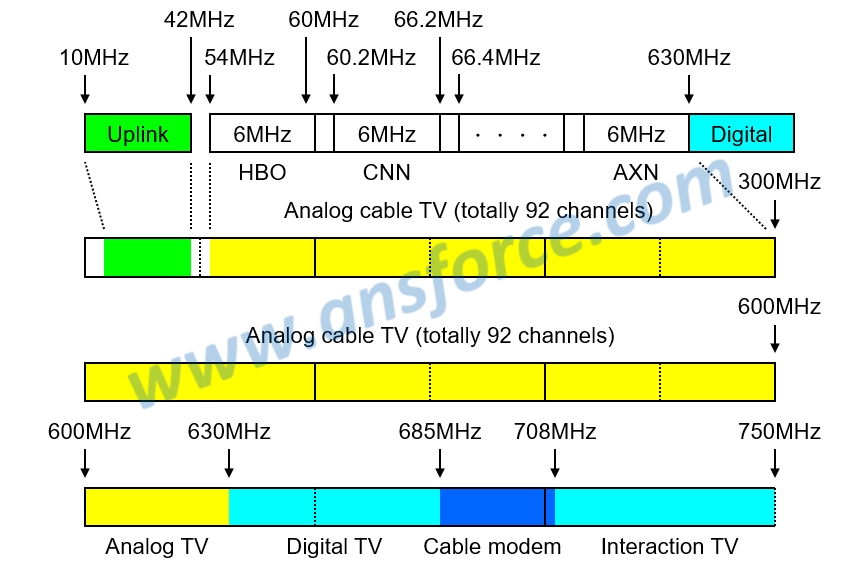
Figure 2: Electromagnetic spectrum of Cable TV.
For analog cable TV, if the bandwidth for each channel is wider, the video quality will be better, but the total channel number will be fewer (fewer TV station number); on the opposite, if the bandwidth for each TV station is narrower, the video quality will be worse, but the total channel number will be more (more TV station number), so you cannot have your cake and eat it too! Therefore, analog cable TV finally decided to use the bandwidth of 6MHz for transmitting analog video in VGA resolution (640x480). The video quality was not so good, and the analog signal is easily got interfered, so the screen would be frequently glitter, like raining and the eyes will feel very uncomfortable. Furthermore, the cable TV in the early stage utilizes analog signals, and most of the bandwidth was used to transmit analog cable TV channels, but only the bandwidth of 630~750MHz was used to transmit digital TV and cable modem.Following the technology development, cable TV shall definitely be fully digitized in the future. Because the original analog cable TV stations are still broadcasting, these channels would be recalled slowly to be used by digital cable TV. Moreover, the latest technology can use the coaxial cable to transmit the electromagnetic wave of maximum 860MHz and even of 1GHz, so as to increase the bandwidth. However, it is difficult to further increase the frequency, because the coaxial cable is suitable for transmitting electromagnetic wave in MHz scale. For transmitting electromagnetic wave in GHz scale, the waveguide should be the most appropriate medium.
【Example】Analog TV and Digital TV
➤Analog TV: Cable TV in the early stage utilized analog signals and most of bandwidth was used to transmit analog cable TV channels. As shown in the example of Fig. 1, the bandwidth for each channel of analog cable TV is 6MHz. This bandwidth may approximately transmit analog video in VGA resolution (640x480). The total bandwidth is 576MHz(54~630MHz) capable of only transmitting 92 analog videos in VGA resolution (640x480).
➤Digital TV: Currently, cable TV has gradually changed to utilize digital signals. As shown in the example of Fig. 1, by utilizing digital modulation technique (256QAM), the bandwidth of 6MHz can at maximum transmit about 20 digital videos in VGA resolution (640x480), equal to increasing 20 times of bandwidth. The total bandwidth is 55MHz(630~685MHz) capable of transmitting about 180 digital videos in VGA resolution. We will discuss thereafter about why the digital signal is so good.
【Remark】The aforementioned contents have been appropriately simplified to be suitable for reading by the public, which might be slightly differentiated from the current industry situation. If you are the expert in this field and would like to give your opinions, please contact the writer. If you have any industrial and technical issues, please join the community for further discussion.