
文章內容

Composition of Internet

❒ Types of Internet
Generally, Internet may be categorized into three types according to the size of distribution scope and area:
➤ Local Area Network (LAN): Computer network is distributed within a “smaller and limited” scope. LAN may be distributed in one company, one college or one residence. Because the transmission distance is very short, the transmission reliability is rather high, and the transmission speed is rather fast, the application range is the widest, such as college campus network, Intranet, home network, etc.
➤ Metropolitan Area Network (MAN): Computer network is distributed within a “larger but limited” scope. MAN may connect each of LANs and the network structure is more conscientious and easier to control. Because the transmission distance is not so long, the transmission reliability is better, and the transmission speed is faster, the application range may be wider, such as networking between banks in a city.
➤ Wide Area Network (WAN): Computer network is connected within a “huge and hardly estimated” scope. WAN is formed by connecting different LANs. The network structure is loose and not easily controlled. Because the transmission distance is longer, the transmission reliability is not so good, and the transmission speed is slower, the application may be limited.
❒ Internet connection
As shown in Fig. 1, Internet connection includes four possible connection methods:
➤ LAN-LAN: Using brides to connect two different LANs, such as LAN at EE department and LAN at MS department in a college, as shown in Fig. 1(a).
➤ LAN-WAN: Using routers to connect the LAN at EE department in a college to WAN outside the campus, as shown in Fig. 1(b).
➤ LAN-WAN-LAN: Using routers to connect the LAN at EE department in a college to WAN outside the campus, and to the LAN in another college, as shown in Fig. 1(c).
➤ WAN-WAN: Using gateways to connect two different WANs, such as Internet and Public Switch Telephone Network, as shown in Fig. 1(d).
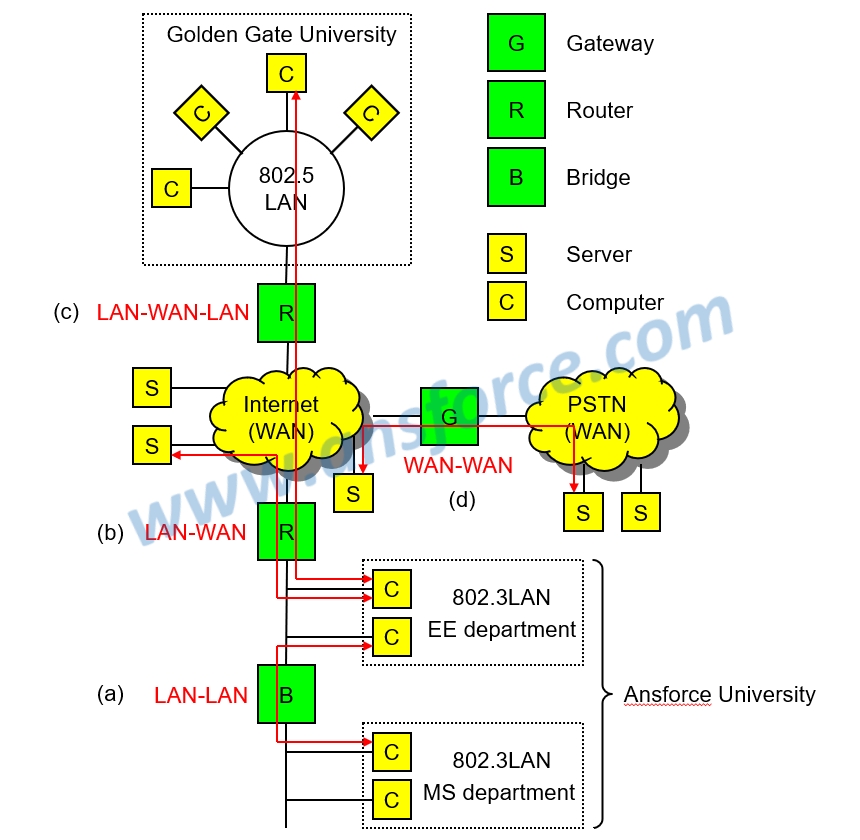
Figure 1: Types of Internet connection.
❒ Nodes in a network
The communication device connected with Internet is generally called a “node,” including personal computer, tablet, smart phone, etc. capable of connecting to Internet. The following devices are communication equipment on the network:
➤ Repeater: Belonging to “unintelligent” node and capable of connecting only LANs of the same type, as shown in Fig. 2(a), for extending the network range. Repeater is only responsible for receiving data, duplicating data, and then transmitting to another segment of network without database, and can only read and write the physical layer (Header 1) of a packet. “Hub” used in a general Ethernet is a repeater.
➤ Bridge: Belonging to “intelligent” node and capable of connecting LANs of the same type or different types, as shown in Fig. 2(b). Bridge is responsible for receiving data, determining the transmission direction, duplicating data and then transmitting. A bridge has a database, and may determine the transmission direction and read and write the physical layer (Header 1) and the data link layer (Header 2) of a packet. “Switch” or “Switching hub” used in a general Ethernet is a bridge.
➤ Router: Belonging to “intelligent” node and capable of connecting LANs and WANs of the same type or different types, as shown in Fig. 2(c). Router is responsible for receiving data, determining the transmission direction, duplicating data and then transmitting. A router has a database (routing table) and the learning capability, and may automatically update the database (routing table) and read and write the physical layer (Header 1), the data link layer (Header 2), and the network layer (Header 3). Router is the most commonly used node for Internet.
➤ Gateway: Gateway belongs to “intelligent” node and is the node at the highest tier, and may connect WANs of different types, as shown in Fig. 2(d). The gateway is responsible for receiving data, determining the transmission direction, duplicating data and then transmitting. A gateway has a database (routing table) and the learning capability, and may automatically update the database and read and write Header 1~Header 7 according to different functions.
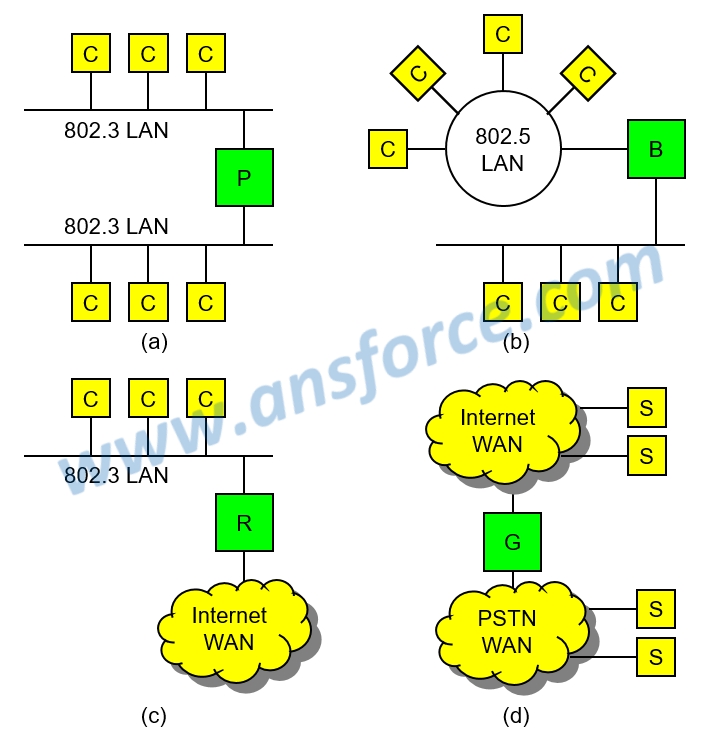
Figure 2: Nodes in a network.
【Remark】The aforementioned contents have been appropriately simplified to be suitable for reading by the public, which might be slightly differentiated from the current industry situation. If you are the expert in this field and would like to give your opinions, please contact the writer. If you have any industrial and technical issues, please join the community for further discussion.