
文章內容

Spin Coating

❒ Features of spin coating
Spin coating has no chemical reaction occurred in the process of film growth. Because spin coating needs no vacuum in the process and the film may be coated on a substrate rapidly in a large amount, the cost is very low and it’s suitable for mass production in factory. However, the coating material must be melted in chemical solution and the thickness of coated film will be larger. Spin coating is often used for coating of the photoresist in the manufacture of integrated circuit or for producing organic light or wave guiding device.
❒ Processing flow of spin coating
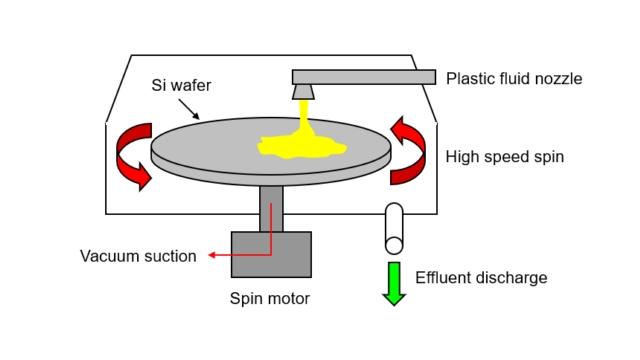
Making the example of coating amorphous acrylic plastic film, as shown in Fig. 1, the processing steps are as follows:
1. Placing Si wafer into spin coating machine as substrate.
2. Melting acrylic plastic material in organic solvent, like acetone, then spraying onto the surface of Si wafer.
3. Rotating Si wafer in high speed to spread the acrylic solution on the surface of Si wafer and make the solution evenly distributed; and evaporating the solvent, i.e. acetone, in the solution to form amorphous plastic film.
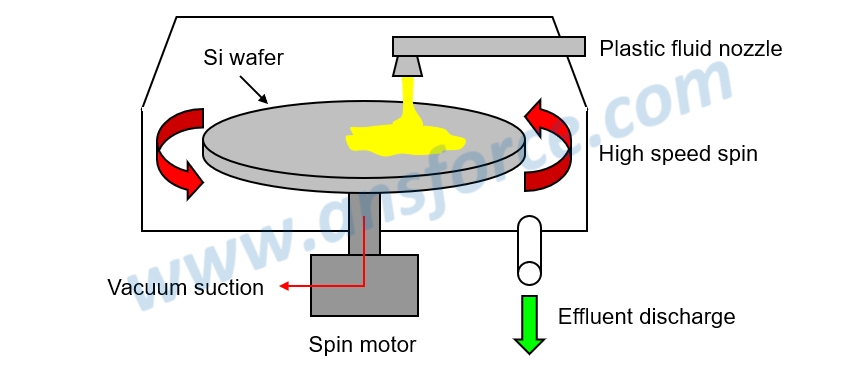
Figure 1: Illustration of spin coating system.
❒ Principle of spin coating
The principle of spin coating is similar to using correction fluid or painting. Correction fluid is prepared by dispersing titanium dioxide powder in organic solvent (usually methylcyclohexane), like dispersing milk powder in water. When we applied the correction fluid on paper and blew for drying, the organic solvent may be evaporated and a layer of white titanium dioxide powder is left on the paper. Paint is prepared by dispersing white titanium dioxide powder (or powders in other colors) in organic solvent (usually methylbenzene). When we applied the paint on metal and blew for drying, the organic solvent will be evaporated and a layer of white titanium powder (or powders in other colors) is left on the metal. Spin coating is to melt organic compound, like plastic, photoresist, in organic solvent, like acetone; then, spraying the plastic solution onto Si wafer; rotating the Si wafer in high speed to make the solution evenly distributed on the surface of Si wafer; and, making the solvent in the solution evaporated to form amorphous plastic film.
【Common sense】Oil paint and water-based paint
The paint using oil solvent is called “oil paint,” and the paint using aqueous solvent is called “water-based paint”:
➤ Oil solvent: Using chemicals that are not soluble in water, like benzene or alkane, as solvent; oil solvent has better volatility and will be rapidly dried after application. Marker pen or Spray paint in our daily life employ oil solvent. Because they may be rapidly dried, their adhesion will be better and cannot be removed by eraser.
➤ Aqueous solvent: Using chemicals that are soluble in water, like alcohol or ether, as solvent; aqueous solvent has lower volatility and will be slowly dried after application. Whiteboard pen or cement paint in our daily life employ aqueous solvent. Because they may be slowly dried, their adhesion will be worse. The traces made by whiteboard pen may be removed by eraser.
【Remark】The aforementioned contents have been appropriately simplified to be suitable for reading by the public, which might be slightly differentiated from the current industry situation. If you are the expert in this field and would like to give your opinions, please contact the writer. If you have any industrial and technical issues, please join the community for further discussion.